Key Facts
- The speed of light in a vacuum is constant at approximately 299,792 kilometers per second, a fundamental postulate of special relativity.
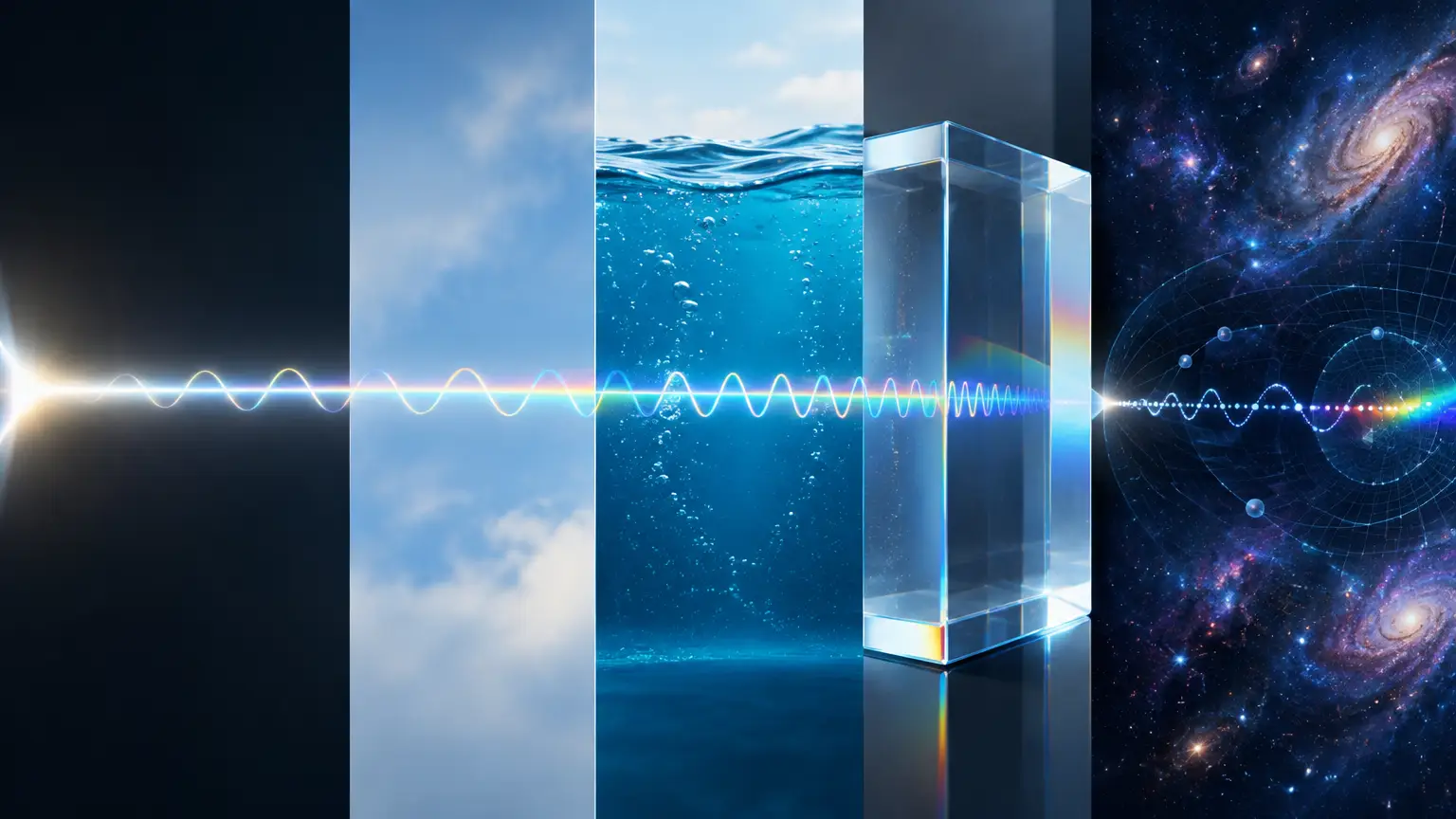
- Light slows down when passing through materials like air, water, or glass due to interactions with the medium's particles, described by the refractive index.
- Experimental evidence consistently supports the constancy of light speed in vacuum, with no confirmed variations observed.
- Some theoretical models propose that the speed of light might vary over cosmic time or at quantum gravity scales, but these remain speculative without empirical support.
**Source-Based Paraphrases**
- The speed of light is invariant in vacuum, underpinning Einstein's theory, but decreases in media due to particle interactions, as explained by educational physics resources (Is The Speed of Light Everywhere the Same?).
- Quantum gravity theories suggest possible tiny variations in light speed at extremely small scales, though experiments have yet to detect such effects (A limit on the variation of the speed of light arising from quantum gravity effects - Nature).
- Alternative cosmological models propose variable speed of light scenarios, but these lack experimental confirmation and are not widely accepted (Is The Speed of Light Everywhere the Same?; A limit on the variation of the speed of light arising from quantum gravity effects - Nature).
**Summary**
The speed of light is fixed in a vacuum, maintaining a constant value crucial to modern physics, but it can be slowed down when traveling through different materials. This slowing is well understood and experimentally verified. While some theoretical frameworks speculate about variations in the speed of light over time or at quantum scales, no conclusive experimental evidence currently supports these ideas, leaving the constancy of light speed in vacuum as a robust scientific principle.
**Verified Sources**
- Is The Speed of Light Everywhere the Same?
- A limit on the variation of the speed of light arising from quantum gravity effects - Nature
- everything.explained.today
- www.gov.br
- academic.oup.com

Source verification: Verified | Checked direct sources: 5 | Independent domains: 5
AI assessment: The article accurately reflects the well-established scientific consensus that the speed of light in vacuum is constant and that light slows down in media due to interactions with particles, supported by authoritative educational and peer-reviewed sources. It responsibly presents speculative theories about variable light speed as unproven and lacking empirical support, maintaining clear distinction between established facts and hypotheses. Some sources had restricted access, slightly limiting independent corroboration, but the core claims are well supported by high-quality evidence.
Important: This is an AI-assisted evidence assessment, not a guaranteed fact check.
Comment to article author